
How does the Alaska natural gas pipeline fit into the overall domestic energy demand picture? The image below is a Sankey diagram of US energy flows based on the 2009 Energy Information Agency Annual Energy Review.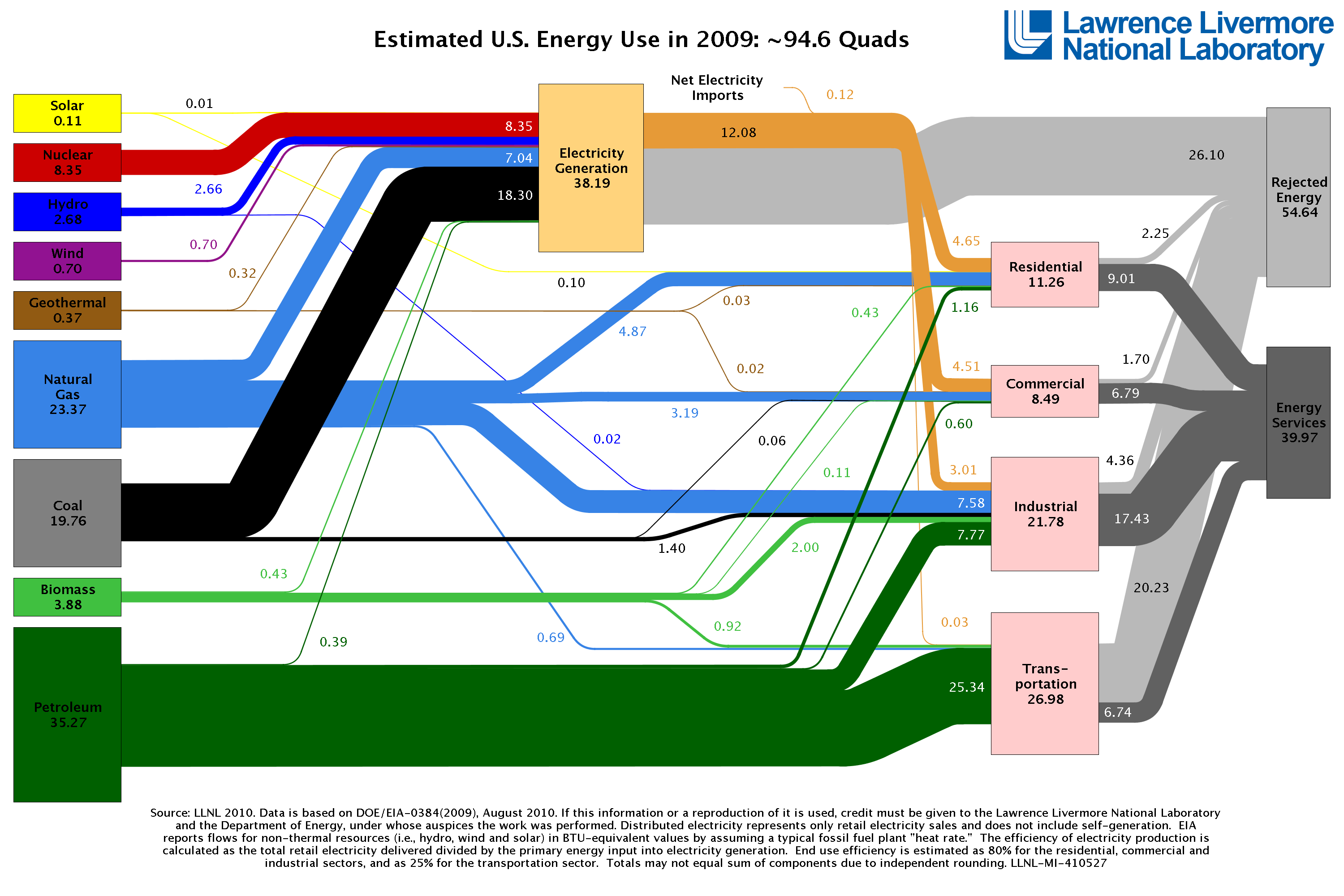 I like this diagram because it shows the relative contribution of various energy sources and puts the Alaska natural gas pipeline into perspective.
The proposed Alaska gas line will deliver 4.5 billion cubic feet per day. In units of "Quads" that equals 1.67 Quads per year. That equals 7% of the current total natural gas demand or 1.7% of the total energy used. If consumed for electrical power it would equal 4.4% of the total energy input for electrical power. Now 2% of all energy or 4.4% of fuel for electricity may not sound like much, but we're talking about a single project.
Compared to Coal: One thing the diagram does not show is the relative efficiency of fuels. Natural gas can be burned for power generation in a combined cycle power plant at efficiencies of 55-60%, an average coal plant converts BTUs to kW at an efficiency of around 33%. On an efficiency basis, new high efficiency gas fired plants can be expected to replace aging coal fired plants.
Compared to Nuclear: Again gas fired combined plants are thermally more efficient than nuclear power plants. Unlike nuclear fuel, natural gas plants don't require cooling water utilities for years after shutdown. Gas fired plants are extremely less expensive to build.
Compared to Oil: Today, with our current infrastructure you can't beat the ease of fueling your vehicle with a petroleum product (gasoline or diesel) and jumping back on the road. On a cost per BTU basis it makes less and less sense to use gasoline or diesel instead of natural gas. You can't beat the concept of switching our motoring paradigm from imported oil to domestic gas. Projects like the Alaska gas pipeline can help make that switch possible. Gas can even be used to produce ultra clean grades of diesel fuel via gas to liquids (GTL) technologies. Gas can also fuel the projects in Canada that recover heavy oil and oil from bituminous sands. Sooner or later natural gas or products of natural gas will fuel your engine.
Friday, April 22, 2011
Perspective


Sunday, April 10, 2011
Natural Gas Cheerleaders
Some say shale gas has ruined the chances of an Alaska Gas Pipeline. I'll agree that the flood of cheap shale gas in the lower 48 has been a great set back to the sure thing envisioned by Frank Murkowski back in 2006 (Link to Murkowski op-ed piece in the News-Miner). Murkowski's loss of the Governorship to Palin coincided with the growth of shale gas development. Palin's policy shift from Murkowski's plans was the wrong move at the wrong time. Shale gas development reset the pricing basis for natural gas in North America. The one-two punch of Palin+shale gas was the black swan event that may ultimately prove fatal to the Alaska Gas Pipeline.
Of course the resources and the demand haven't gone away. Businesses will adjust and invest in development projects in places with more favorable conditions. Just listen to ExxonMobil CEO Rex Tillerson gush about doing business in Qatar and the acquisition of shale gas producer XTO:
The producers, like ExxonMobil are in this business for the long haul, they'll continue to meet market demands and manage risk with or without Alaska gas. Closure of facilities like the Kenai LNG export terminal shows that market forces govern the sale of Alaska energy and wishing it otherwise won't help.
So who is optimistic about North American natural gas? The shale gas folks of course. ExxonMobil bought XTO and took the lead in shale gas followed by Chesapeake. ExxonMobil sees a bright future for natural gas and so does Chesapeake (Link to Chesapeake Presentations).
The April 2011 Chesapeake investor presentation explains why they are bullish on natural gas. They see a future with compressed natural gas vehicles (CNG), LNG export from the lower 48, and gas to liquids plants fed by cheap and abundant shale gas. They also envision replacement of coal power plants with natural gas power plants: I agree with Chesapeake's reasoning and ExxonMobil's optimism for the future of natural gas. The demand is great and they have bought the resources at the low point in the cycle. I think Alaska, as a resource owner, should also be optimistic. The selling price of natural gas will be constrained by production cost and the cost of alternatives. The alternatives: coal, oil, and nuclear all have future cost problems, the end result is long term gas prices in the $6/MMBTU range and sufficient demand for a couple of Arctic pipelines.
Precedent agreements explained
Here's a link to a good explanation of the ongoing precedent agreement phase of the Alaska Gas Pipeline (By Bill White, Researcher/Writer for the OFC) (LINK) Here's a quote from the article, spelling out what we can expect in the weeks, months and years ahead.
Disclosure of Precedent AgreementsNice article Mr. White - Thanks.
As was said, precedent agreements usually get unveiled, in whole or part, when a developer applies to FERC for a certificate to construct and operate a pipeline. The agreements are the developer's affirmation that the project is needed.
For the Alaska pipeline projects, those certificate applications aren't planned until the fall of 2012 for the Alaska Pipeline Project and 2013 for the Denali project.
In an unusual move, FERC decided in 2005 to handle disclosure of the Alaska projects' precedent agreements differently. FERC's Alaska-specific regulations disallow withholding from the public the existence of signed agreements until the certificate filing.
The developer must issue a press release within 10 days of executing each precedent agreement disclosing the name of the shipper, the amount to be shipped and how many years the shipping will last. Then the developer must file the actual precedent agreement with FERC within 20 days of signing it, although the developer can ask FERC to seal the agreement so the public can't see its details. In handling past pipeline projects, FERC typically granted requests for sealing these documents.
Sunday, April 3, 2011
The Nat Gas Act
External events may drive construction of the Alaska Gas Pipeline. The NAT GAS Act, pushed by oilman Boone Pickens is gaining momentum in Washington. The proposed law provides incentives for converting vehicles to compressed natural gas. (LINK: Natural Gas Vehicles for America).
Converting vehicles to natural gas will reduce demand for foreign oil and increase demand of domestic gas. Even the President says he endorses the plan (LINK).
If this measure passes, the price of natural gas may climb back to the $5 to $6/MMBTU range and justify construction of the Alaska Gas Pipeline.
Exporting LNG from North America may sponge up additional excess gas supplies (LINK) and help close the unit cost disparity between natural gas ($4/MMBTU) and crude oil ($18/MMBTU).
Natural gas vehicles, LNG export, and gas fired power generation will combine to redefine the energy equation in North America and maybe, just maybe help justify the Alaska Gas Pipeline.
Sunday, March 27, 2011
The Canadians move ahead
In the snails paced world of arctic gas development the Canadians have pulled ahead. First, Kitimat LNG has awarded a Front End Engineering Design (FEED) contract to KBR, and announced plans to pursue an expansion of their project. The first plant will process 700 million cubic feet per day into about 5.5 million tons per year of LNG. Proposed expansion could add another 1 MTPA capacity. The proposed customers are in Asia and the target sales price of product is quoted at $12/MCF vs. $4/MCF in North American markets for the same gas. The Kitimat volumes are roughly 18% of the volumes of the Alaska Gas Pipeline project. Project description video from Kitimat webpage (LINK).
Secondly, the Canadian National Energy board has given the green light to the Mackenzie pipeline project. When completed the Mackenzie could move up to 1.2 Billion cubic feet per day of gas or about 26% of the capacity of the Alaska Gas Pipeline. In terms of capacity the two Canadian projects will market about 44% of the volume of the Alaska Gas Pipeline. Best wishes to both projects - It's great to see some forward motion.
Sunday, March 20, 2011
The end of Nuke as we know it?
Last weeks events in Japan may spell an end to the renewed pursuit of nuclear power in the United States and set the stage for increased use of natural gas for base load power generation.
I'm not talking about the knee jerk reaction you can see 24/7 on Fox News or CNN. Instead it simply looks like the cost of nuclear power just went up beyond the point of feasibility.
This 2008 study (LINK) compares the cost of various power generation technologies. In Table 4, the baseline cost of combined cycle natural gas is $61.77/Mwh and Nuclear is $83.33/Mwh. Table 14 shows the cost of combined cycle natural gas climbing to $94.90/Mwh if the plant is equipped with carbon controls. The reader is lead to assume that nuclear power is the less expensive power source after gas-fired plants are fitted with carbon controls.
Of course carbon controls on a combined cycle power plant is a false choice. Utilities like TVA see the light and include natural gas in their power generation mix as they ramp down older coal fired capacity (LINK). Also pencil in some gas-fired capacity to take up the slack on calm days when wind power sits idle. Page 72 of the TVA study addresses base load capacity the hints that the cheap shale gas may tip the scale in favor of gas-fired generation:
"Baseload generators are primarily used to meet energy needs during most hours of the year due to their lower operating costs and high availability. Even though baseload resources typically have higher construction costs than other alternatives, they have much lower fuel and variable costs, especially when fixed costs are expressed on a unit basis. An example of a baseload resource that provides continuous, reliable power over long periods of uniform demand is a nuclear power plant. Some energy providers may also consider natural gas-fired combined cycle plants for use as incremental baseload generators. However, given the historical tendency for natural gas prices to be higher than coal and nuclear fuel prices when expressed on a unit basis, a combined cycle unit may be a more expensive option for larger continuous generation needs. As the fundamentals of fuel supply and demand continue to change and if access to shale gas continues to grow, this relationship may change in the future." (emphasis added).
Long-term contracts for natural gas are cheap at the moment. Many think that shale gas may provide long term stability for gas prices in the $4 to $6/MMBTU range. The installed cost of the plant can be estimated with a high degree of accuracy. The chance of a cost overrun for a gas-fired plant is low. A combined cycle gas plant is very bankable.
On the other hand nuclear plants are expensive and subject to delays and unexpected cost escalation. We still lack a workable plan to store or process spent fuel. The incident in Japan will likely result in studies and new regulations for new and existing plants. Those studies will add cost, uncertainty and delays. Less bankable.
I've worked a few nuclear projects and the more I learn about nuclear plant design and operation the more I study the thinking of Nassim Nicholas Taleb author of The Black Swan: The Impact of the Highly Improbable. In the coming weeks and years we'll learn the total impacts of the highly improbable events witnessed in Japan.
There's no time like the present to build a gas line from the North Slope.
Saturday, March 12, 2011
Arctic Gas Headlines
Mackenzie bounces back - First Oil 2018, Construction in 2013 claimed. Sounds good to me.
Mackenzie pipeline wins federal cabinet approval after years of delay
"The next step will be for the project’s backers, which also include ConocoPhillips, ExxonMobil, Shell and the Aboriginal Pipeline Group, to resume negotiations with the federal government over a fiscal framework."Where have I heard that before?
Point Thomson Talks Continue - Important source of Alaska gas for the pipeline.
Global LNG-Japan tsunami bullish for Asia LNG spot market LNG and fuel oil to fill the gap.
Denali Alaska pipeline project to miss deadline
FERC reports to Congress on the Alaska Gas Pipeline
TC Alaska has stated that it is intensifying its efforts to finalize its project design and compile the information necessary to file a complete application with the Commission in October 2012.Mine Wants to Build Gas Pipeline From Cook Inlet - The next pipeline project?
NovaGold says it wants to build a natural gas pipeline from Cook Inlet to provide power to its Donlin Creek Mine near the Kuskokwim River

 Posts
Posts


